Preliminary Roost Assessment Survey
Preliminary roost assessment surveys are undertaken to record bat presence and evidence of use by bats both internally and externally within a built structure, also recorded is the ponetial for roosts to be present. They can be undertaken at any time of the year.
An inspection survey requires the surveyor to assess whether bats are currently present, have been present or have the potential to be present. A variety of equipment is used to examine the structure internally and externally this includes an endoscope, inspection mirrors, binoculars, and a high-powered torch. The following evidence would be recorded:
Some structures require the use of access platforms to fully inspect the external and internal walls and roof. All features of a structure are checked for bat activity and the presence of bats. Inspection surveys of trees require either climbing or the use of access platforms depending on the location and state of the tree to be surveyed. The Wildlife Survey Unit employ LANTRA qualified tree-climbers, we also have extensive experience of the use of access platforms. All survey methods follow the methodology given in the Bat Conservation Trust's Bat Survey: Good Practice Guidelines 3rd Edition. |
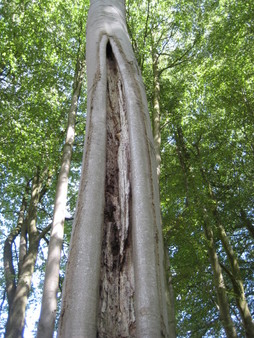
Large cavity in a Beech tree creating a roosting site for a single Daubenton's bat
|